

Walk-In Cooler Repair in Galveston, TX
Repair for walk-in coolers, including temperature problems, failed compressors, door seals, and evaporator issues.
Recent Walk-In Cooler Repair work in Galveston
Real jobs completed by our team in the Galveston area
Brandon
September 2026
Frozen Walk-In Cooler Needed Two Days to Thaw in Galveston
What the customer reported
A Galveston business reported that the ICE box outside was not working and asked for a look over everything on the roof for maintenance.
What we found and did
The walk-in cooler was heavily frozen and required approximately two days to fully thaw before service could be completed. Brandon replaced the walk-in cooler time clock, adjusted the TXV to achieve proper evaporator superheat, fixed the drain lines, adjusted the thermostat, cleaned the evaporator, and added 2 pounds of 404A. On the rooftop package units, he replaced all capacitors, including the fan capacitors, and cleaned all the condensers with water.
Result
Brandon checked system operation after repairs and adjustments to ensure the equipment was operating properly.
 Before
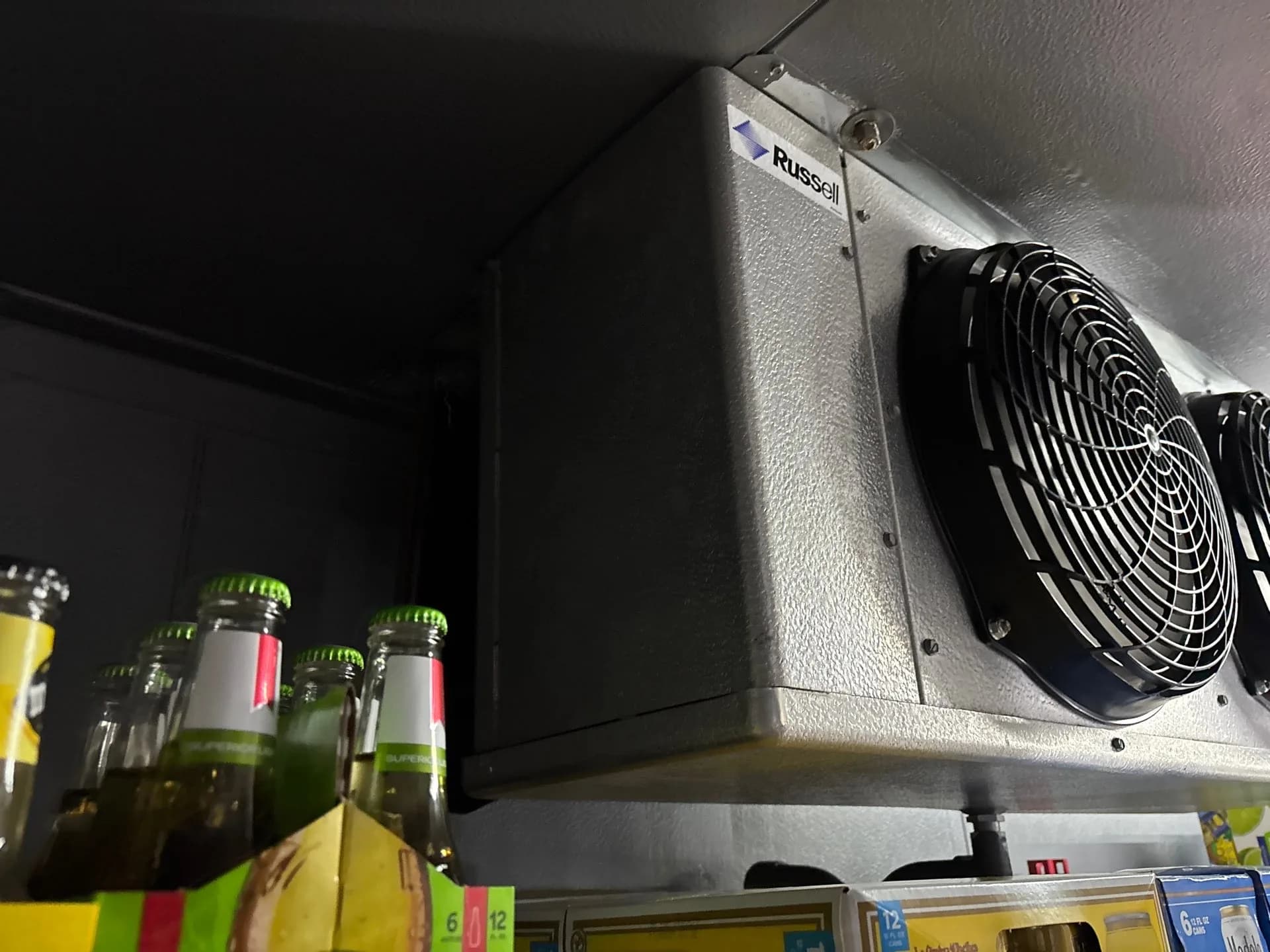 After
After
Gabriel & Matthew
July 2026
Walk-In Cooler Stopped Cooling at a Galveston Business
What the customer reported
A Galveston business reported that its walk-in cooler was not working.
What we found and did
Gabriel and Matthew found that the evaporator coil and the condenser coil were very dirty and needed cleaning. They chemically cleaned and brushed the evaporator coil and the condenser coil, then started up the unit and measured a 10° split. The technicians came back the next morning to check for any freeze up and found none.
Result
The unit had a 10° split, which is very good, there was no freeze up the next morning, and the system is cooling very well now.
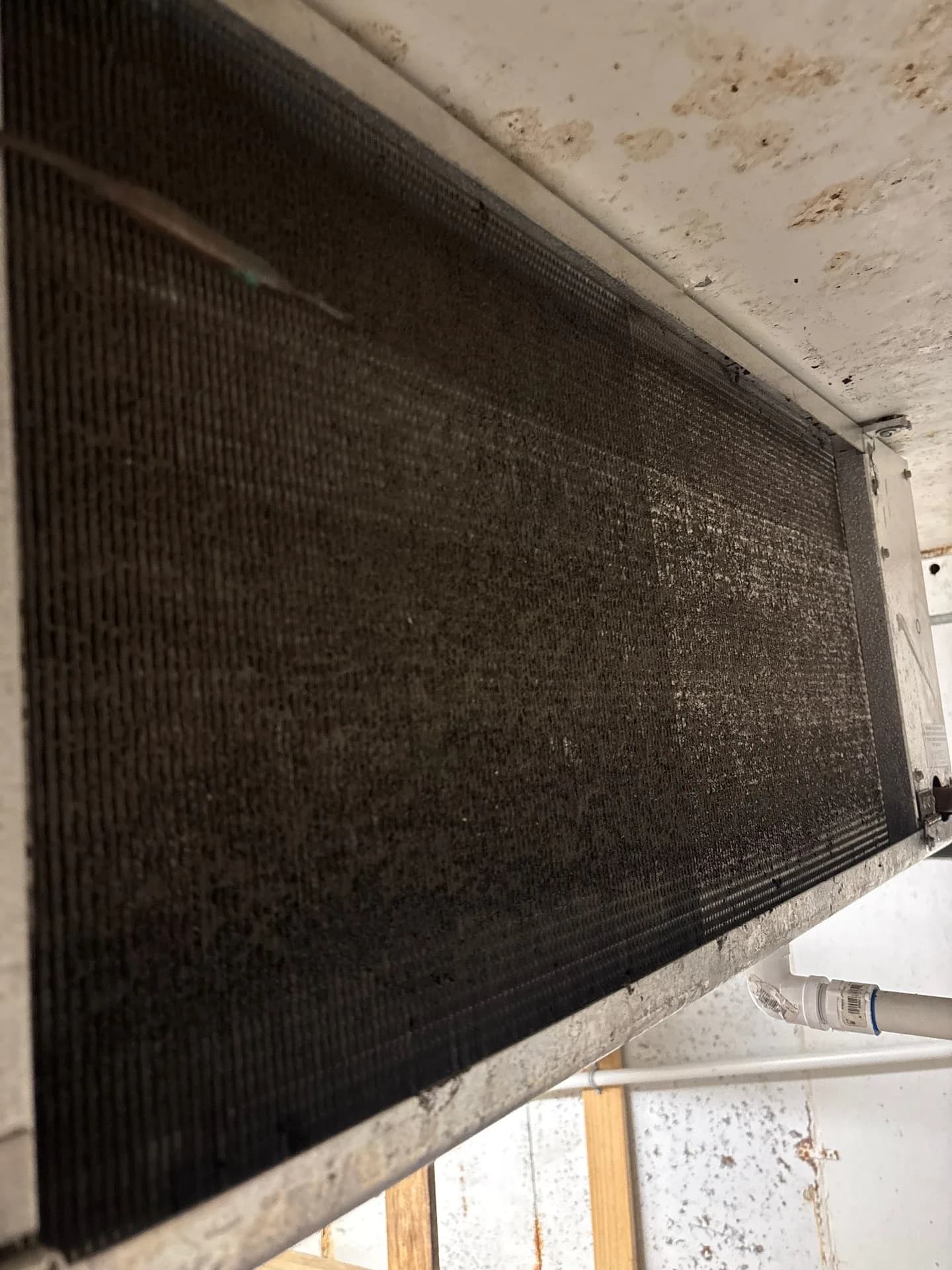 Before
 During
 After
AfterWhat is Walk-In Cooler Repair?
What a walk-in cooler actually is
A walk-in cooler is a refrigerated room, and it runs on the same basic parts as an air conditioner: a compressor, a condenser, an evaporator, a refrigerant circuit, and a set of electrical controls that decide when it all runs. The compressor and condenser pull heat out of the box and move it outside. The evaporator inside circulates cold air across your product. When that loop is healthy, the room holds a steady temperature and you never think about it. When one part slips, the whole box drifts warm.
We work on HVAC systems every day, which means we already work on this exact machine. Refrigeration is the same core equipment tuned to hold a lower temperature over a bigger load, so when your cooler starts creeping, we're not learning on your dime.
Why this matters in a restaurant
A walk-in that runs a few degrees warm doesn't announce itself. It just quietly works harder, runs longer, and lets your product sit closer to the edge than it should. By the time someone notices soft produce or a warm shelf, the box may have been struggling for days. Two things are on the line: the product inside, and the inspection that checks whether your cold storage holds food-safe temperatures. A cooler that can't stay in range puts both at risk.
There's also the summer factor. On the coast, the box fights harder from May through September, and a marginal system that limped through winter often fails in the heat, right when you can least afford it.
How we approach the work
We start by reading the whole loop, not just the part that looks obvious. A warm box can come from a low refrigerant charge, a dirty or failing condenser, an iced-up evaporator, a bad door seal, or a control telling the system the wrong thing. We check temperatures, airflow, the refrigerant circuit, the defrost behavior, and the door hardware before we call it. That way you get the actual cause fixed, not just the symptom that showed up first.
The salt-air part nobody warns you about
Here in Galveston, the condensing unit usually sits outside, and salt air is hard on outdoor equipment. Coils corrode, fins deteriorate, electrical connections pit, and fasteners rust. We check for salt damage as part of the visit, and when something needs replacing, we spec corrosion-resistant components built to hold up longer in this environment. It's the difference between a repair that lasts and one that's back on your service list next season.
Why call us
We're an owner-led HVAC company, so the person accountable for the work stays close to it. We explain what we found in plain terms, tell you what needs fixing now versus what to keep an eye on, and we don't pad the job. If a repair makes sense, we'll say so. If the box is at the end of its life, we'll tell you that too.
Getting started
If your cooler is creeping, icing, or just not holding like it used to, call and we'll tell you where we can fit you in. We keep restaurants and food-service operations across the island and the nearby mainland running cold. Reach us at (409) 599-1948.
Problems we fix
Our experts diagnose and resolve any issue.
Temperature creep
The box slowly climbs out of its safe range while everything looks normal from the outside. It usually points to a refrigerant, airflow, or control issue rather than a total failure, which is exactly why it goes unnoticed. Catching it early is the difference between a small fix and spoiled product.
Compressor or condenser trouble
The compressor and condenser do the heavy lifting of pulling heat out of the box. When the compressor struggles or the condenser can't shed heat, run times stretch and the cooler can't hold temperature. Dirty coils, a failing fan, or an aging compressor are the usual causes.
Evaporator icing
When the evaporator coil ices over, it can't absorb heat from inside the box, so the cooler actually gets warmer even though it's covered in frost. Airflow problems, low refrigerant, or a defrost fault are common triggers. Chipping the ice off is a symptom fix, not a repair.
Door gasket and hinge failure
Worn gaskets and sagging hinges let cold air leak out and warm, humid air in. The system runs longer to compensate, and you'll often see condensation or frost near the door. New seals and properly hung doors are an inexpensive fix that saves a lot of runtime.
Drain line clogs
The evaporator produces condensate that has to drain away. When the line clogs, water backs up, pools on the floor, and can ice over or drip onto product. A clear drain and a working heater on the line prevent most of it.
Thermostat and control faults
The controls tell the system when to run and when to rest. A drifting thermostat or a bad sensor can leave the cooler running nonstop or not enough, either wasting energy or letting the box warm up. Accurate controls are what keep the temperature steady.
More refrigeration services
Explore our other refrigeration services.
Ice Machine Repair
Diagnosis and repair of commercial ice machines, from low or no ice production to water supply, drain, and refrigerant problems.
Learn moreIce Maker Repair
Repair for residential ice makers, including built-in, under-counter, and refrigerator ice maker units.
Learn moreWalk-In Freezer Repair
Repair for walk-in freezers, including frost buildup, defrost failures, and temperature recovery problems.
Learn moreWalk-In Cooler Repair questions, answered
Common questions about our walk-in cooler repair.
Do you service walk-in coolers in my area?
Yes. We cover food-service operations across Galveston Island, Texas City, League City, Dickinson, La Marque, and Santa Fe. If you're near there and not sure, give us a call and we'll let you know.
How soon can you get to a cooler that's running warm?
It depends on the day and what's already on the schedule. Call and we'll tell you where we can fit you in, and if your product is at risk, tell us that up front so we can factor it in.
Should I repair the cooler or replace it?
It depends on the box and what's failing. A single bad part on an otherwise healthy system is usually worth repairing. A system that's corroded through or repeatedly failing may cost you more in downtime than a replacement would. We'll give you the honest read after we see it.
What temperature should a walk-in cooler hold?
Most coolers run somewhere around 35 to 38 degrees to keep product food-safe, though the right target depends on what you're storing. If your box can't hold that range or keeps drifting up, that's a sign the system is struggling and worth looking at.
How can I keep my cooler from failing in the first place?
Keep the condenser coils clean, check the door seals, and don't ignore small changes like longer run times or a box that's a couple degrees warm. Salt air is hard on outdoor condensing units here, so having someone check for corrosion before summer goes a long way.
Schedule Your $125 Diagnostic
Licensed & Insured
Fully licensed and insured for your protection
24/7 Emergency
Available when you need us most
11+ Years
Over a decade of trusted service