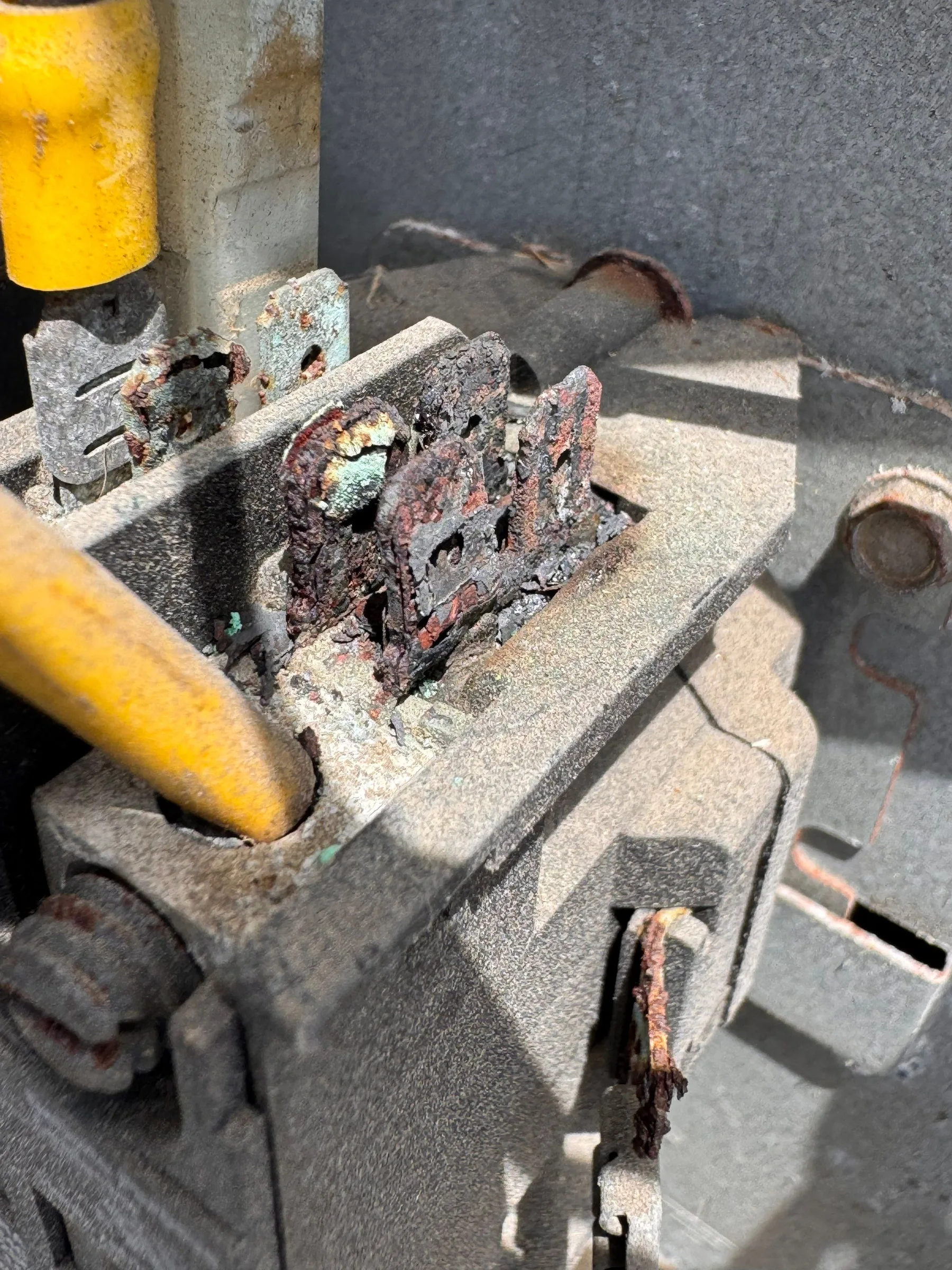
If your rooftop unit sits on a commercial building anywhere near the Gulf Coast, it is taking more punishment than it was designed for. Standard RTUs installed on Galveston and Texas City buildings corrode years ahead of schedule without protection, while the same unit installed well inland can run far longer. Salt air, UV exposure, wind-driven rain, and the humidity that defines this part of Texas account for most of that gap.
The Five Things That Kill Rooftop Units on the Coast
- Salt spray. Wind carries salt particles inland from the Gulf. Rooftop units sit fully exposed with no windbreaks. Salt lands on coils, cabinets, electrical panels, and fasteners, and uncoated aluminum coils start to corrode quickly.
- Humidity. Galveston County humidity stays high most of the year. Moisture condenses on every cool metal surface inside the unit. Combined with salt deposits, this creates a corrosive film that works around the clock. Condensate drains clog and overflow more often in this climate.
- UV radiation. Rooftop units bake in direct Texas sun all day. UV degrades rubber gaskets, plastic components, wire insulation, and refrigerant line jackets. Cracked insulation leads to electrical shorts. Degraded gaskets let rain into panels and compartments.
- Wind. Sustained coastal winds stress cabinet panels, loosen fasteners, and drive rain horizontally into openings that would stay dry on a ground-level unit. During tropical storms, winds can rip loose panels that weren't properly secured, exposing internal components to the elements.
- Storm debris. Branches, gravel, building materials: anything loose on or near the roof becomes a projectile during high winds. Impact damage to coils, fan blades, and refrigerant lines is common after storms.
Signs Your RTU Needs Attention Now
Call before a minor problem becomes a complete breakdown. These signs mean your rooftop unit is already in trouble:
- White powdery residue on coils or cabinet surfaces (active corrosion)
- Rusty water stains on the roof deck around the unit base
- Unusual noises: grinding, rattling, or high-pitched whining from fan motors
- Short cycling: the unit starts and stops frequently without reaching set temperature
- Hot or cold spots in the building despite the thermostat reading correctly
- Visible rust on cabinet panels, curb adapters, or support structures
- Ice forming on refrigerant lines (often low charge from a corrosion-caused leak)
- Higher than normal electric bills with no change in usage patterns
If you're seeing two or more of these, the unit needs professional evaluation before a minor issue becomes a major replacement.
Our RTU Service Approach
We service all major commercial rooftop unit brands: Carrier, Trane, Lennox, York, Rheem, Daikin, and others. Our techs are trained on units ranging from 3-ton single-zone models to 25-ton multi-zone commercial packages. Our service covers three areas.
Diagnostic and repair: We start with a full system evaluation: electrical, mechanical, refrigerant, airflow, and structural. Coastal units have failure patterns that differ from inland equipment, and our techs know what to look for. Common Gulf Coast RTU repairs include coil leak repair or replacement, contactor and relay replacement due to corrosion, condensate drain rebuilds, fan motor and blade replacement, economizer repair, and control board replacement from surge damage.
Corrosion remediation: For units that are mechanically sound but showing corrosion damage, we can apply field-applied coil coatings, replace corroded cabinet panels and hardware with corrosion-resistant alternatives, and seal electrical compartments against moisture intrusion. This can extend the life of an existing unit by years at a fraction of the replacement cost.
Replacement and new installation: When an RTU is beyond economical repair, we spec replacements built for the coast. That means factory-coated coils, stainless or coated cabinets, curb adapters with proper drainage, marine-rated electrical components, and surge protection. We size the replacement to the actual load, not just what was there before. Many commercial buildings have changed occupancy or layout since the original unit was installed.
Hurricane Preparation and Recovery
We provide 24/7 emergency service because storms don't wait for business hours. Our hurricane protocol for commercial RTU clients includes a pre-season checklist and post-storm priority service.
Pre-season prep covers securing all access panels and fasteners, clearing roof drains and RTU condensate drains, testing and verifying surge protection, documenting unit condition with photos for insurance records, and protecting vulnerable components when a storm is approaching.
After a storm, we inspect for impact damage, check refrigerant charges for storm-caused leaks, test all electrical systems for surge damage, clear debris from coils and fan assemblies, and verify condensate drainage after heavy rain.
Contract clients get priority scheduling after storms, when demand for HVAC service across Galveston County spikes.
Proactive RTU Management
A better approach for Gulf Coast commercial buildings is a maintenance contract that includes quarterly service with coastal corrosion monitoring, priority emergency response around the clock, storm prep and post-storm inspection, and long-term equipment condition tracking so you can budget for replacements before they become emergencies.
If your rooftop unit is struggling or you're not sure what condition it's in after years of coastal exposure, call us for an evaluation. We'll get on the roof, assess the damage, and give you honest options: repair, protect, or replace.