September 2026 in review: 109 jobs across the Galveston Bay area
In brief
We completed 109 jobs in September 2026, and diagnostic and repair calls made up the biggest share by far. Humidity, salt air, and a long cooling season kept capacitors, refrigerant, and drain lines busy. Takeaway: the heat isn't done, so keep your drain line and outdoor unit on your watch list.

September 2026 in review, Galveston Bay style: it stayed hot and sticky, the cooling season was far from over, and our trucks stayed busy. We completed 109 jobs for 90 different customers across Galveston, League City, Friendswood, Tiki Island, and a few neighboring towns. Here's what came through, what it says about the season, and what to keep an eye on.
September 2026 in review: the numbers
We completed 109 jobs in September 2026.
The category mix
Here is how the month broke down by kind of work:
- Diagnostic and repair calls: 76 jobs (70%)
- Service visits: 12 jobs (11%)
- Maintenance visits: 6 jobs (6%)
- Ductwork: 4 jobs (4%)
- Installations and replacements: 4 jobs (4%)
- Commercial refrigeration: 2 jobs (2%)
Where the work was
Galveston led with 77 jobs, followed by League City with 6, Friendswood and Tiki Island with 5 each, Houston with 4, Jamaica Beach and Sugarland with 2 each, and Bolivar Peninsula with 1.
What the work says about the season
When about 70% of your month is diagnostic and repair calls, it tells you the equipment is being leaned on hard. September along the bay doesn't feel like fall. The humidity stays high, the nights don't cool the house down much, and systems that started the summer a little tired are now finishing a very long run.
The billed line items tell the same story. Capacitor replacements, refrigerant recharges, and maintenance visits each showed up on 12 jobs. Drain line cleaning and repair appeared on 6 jobs, ductwork and evaporator coil replacements on 5 each, mini split systems on 4, and AC system replacements on 3.
Why those items? A capacitor gives a motor the jolt it needs to start, and it works every time the system cycles. In constant heat it gets a lot of use. Refrigerant problems often come from slow leaks or corrosion, and salt air is hard on copper and fittings. Drain lines carry away all the moisture your system pulls out of humid air, so they clog with buildup. Coils collect dirt and moisture, and a dirty coil can ice over and stop cooling.
Prevention tip: The parts that fail in September are usually the parts that have worked the hardest since May. A tune-up before the heat, and a quick check in the fall, catches many of them while they're still small.
A 10-ton lobby AC unit freezes up in Friendswood
A Friendswood business told us its system wasn't cooling. Our technician found the evaporator coil on the lobby unit frozen solid.
Thawing the ice is only the start, because ice usually has a cause. He melted the ice off the coil, then did a deep cleaning of the 10-ton evaporator coil. That meant removing built-up dirt and debris from the coil and the parts around it, then cleaning and flushing the coil so air could move through it and heat could transfer the way it should. He also cleaned the drain pan and condensate area, inspected the coil and surrounding parts, and verified that the system was operating properly.
In plain language: a dirty coil can't absorb heat well and restricts airflow, the coil gets colder than it should, and moisture freezes on it. Cleaning the coil addresses the cause, not just the ice.
Rusting part on an outdoor AC unit in Galveston
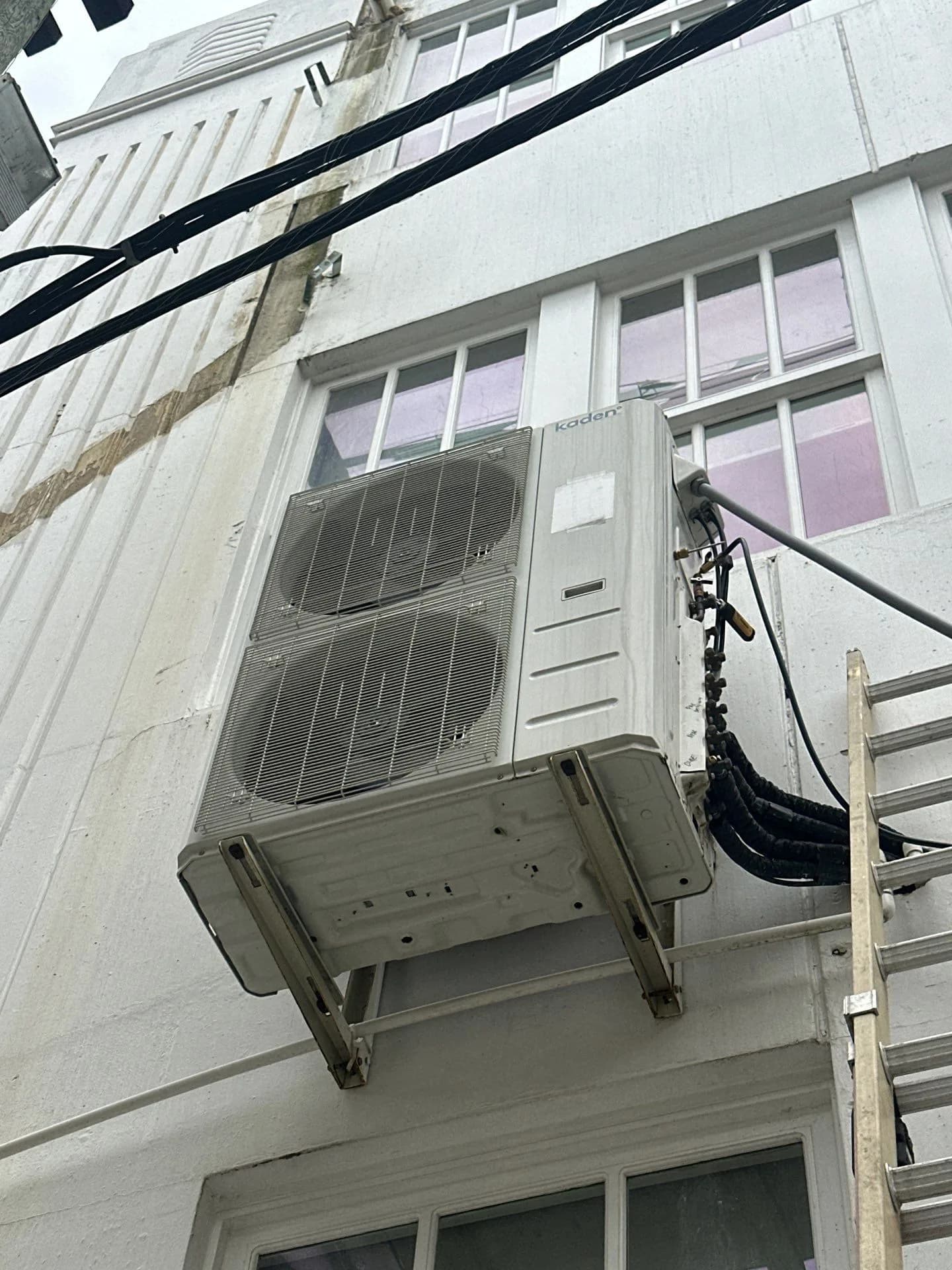
A Galveston homeowner noticed the filter drier was rusting on the outside of their AC system. That small observation led to a bigger find. Our technicians found a rusted out, leaking filter drier, a system almost flat in charge, exposed low voltage control wires, and insulation baked off by the sun.
Here's what the repair involved:
- We recovered the remaining refrigerant so nothing was released.
- We cut out the old drier and brazed in a new copper drier and a brass sight glass, which gives a quick visual reference for the charge. Nitrogen flowed through the lines during brazing to keep the inside of the pipe clean.
- We swept the system with nitrogen, then pulled a vacuum from both sides down to below 500 microns. That removes air and moisture, which don't belong in a sealed system.
- We weighed in approximately the system charge, then added refrigerant to reach the required levels on both the high and low side, and commissioned the system.
This is what salt air and sun do over time. Rust on a fitting is a warning, and a customer who points at it early can save the compressor from running low on charge.
Safety first: Exposed low voltage wires and a leaking refrigerant line are not do-it-yourself territory. Keep kids and pets away from the outdoor unit and have it looked at.
Attic AC quits cooling in late September in Galveston
Another Galveston homeowner called because their AC wasn't working. Our technician found a backed up condensation line and a tripped float switch in the pan. The float switch is a safety device, and when water rises in the pan it shuts the system off so the water doesn't spill into the attic or ceiling.
He vacuumed the clog out of the drain line, then flushed the line with water from the attic down to the vacuum outside. A lot of debris came out. He reset the float switch, confirmed the drain was flowing freely, and the system was running and cooling as normal.
Pro tip: If your AC stops cooling and the system is in the attic, a water-stained pan or a drip near the unit is a good clue that the drain line needs attention.
What the reviews said
Google reviews dated in September 2026 numbered 10, with a 5.0 average and all five stars. One customer wrote that the team "communicated their plan clearly and executed with true professionalism." Another review said we did an "excellent job explaining what was being done." Explaining the plan is something we care about, so those comments mean a lot.
What to watch for as September turns into next month
Don't put the AC to bed yet. Our fall is warm and muggy, and cooling systems keep working well into the next month. A few things are worth watching:
- Drain line and pan: If you notice water near the indoor unit or the system shuts off unexpectedly, check for a clogged line or tripped float switch.
- Ice on the coil or lines: Ice means airflow or charge is off. Turn the system off to let it thaw and call us.
- Rust and sun damage outside: Look for rusted fittings, flaking insulation on the lines, and loose or exposed wires.
- A system that hums but won't start: That can be a capacitor or wiring issue, not a low refrigerant problem.
- Equipment in hot spaces: A League City homeowner's garage ice machine reminded us that equipment has a rated maximum ambient temperature. With the garage door almost shut, the space ran hotter than the unit was designed for. Give equipment room to breathe.
When to call a pro: Ice, water, a burning smell, a breaker that keeps tripping, or a system that runs without cooling are all signs to stop and call us.
Get in touch
If your system is acting up, or you'd like a look at it before the season changes, reach out to the team. We're glad to walk you through what we find and what it means.
Frequently Asked Questions
Does my AC need refrigerant if it isn't cooling?
Not necessarily. A Galveston homeowner called us thinking their AC needed refrigerant. The real problem was that the compressor wasn't starting because the wiring on the capacitor was wrong. Once we corrected the wiring, the system ran great. A proper diagnosis comes before any recharge.
Why does my AC freeze up?
The usual causes are restricted airflow, such as a dirty coil or filter, or a system that is low on charge. Moisture on a coil that is too cold turns to ice. Thawing and cleaning the coil, then checking airflow and charge, is how we get to the cause.
Why is a clogged drain line such a big deal in humid weather?
Your AC pulls a lot of moisture out of humid air, and the drain line carries it away. When the line clogs, the pan fills and a float switch can shut the system off. Clearing the line and resetting the switch usually gets the system cooling again.